

The Missing Frontend for AI Services
I designed SuperCrew Studio as a human-in-the-loop mission control UI for AI agencies, dev shops, and automation studios. It turns invisible agent workflows into a visible product layer their clients can actually understand.
Outcomes
- Mission-first interface around existing tools
- White-label UI kit for agencies
- Ledger & reporting for tokens, assets, missions
The problem I was solving
AI work suffers from a black-box problem. From my perspective, studios were dealing with messy chat threads, endless Looms, and scattered Google Drive folders. Clients couldn't see the value of the backend orchestration, which meant agencies couldn't easily justify their pricing.
My hypothesis
I hypothesized that adding a visible mission layer based around a mental model of Missions, Crew, and Artifacts—alongside structured human-in-the-loop checkpoints—would make complex AI work legible, defensible, and highly billable.
How I approached the system design
Map real AI workflows
I analyzed how dev shops were actually building with tools like LangChain and CrewAI. I abstracted their common execution patterns into a universal flow, focusing on the structures rather than the underlying compute.
Define the Mission / Crew / Artifact model
I introduced a core mental model that translated abstract APIs into tangible deliverables. Missions represent scope, Crew represents the executing agents, and Artifacts represent the billable output.
Prototype the mission workspace around live ops
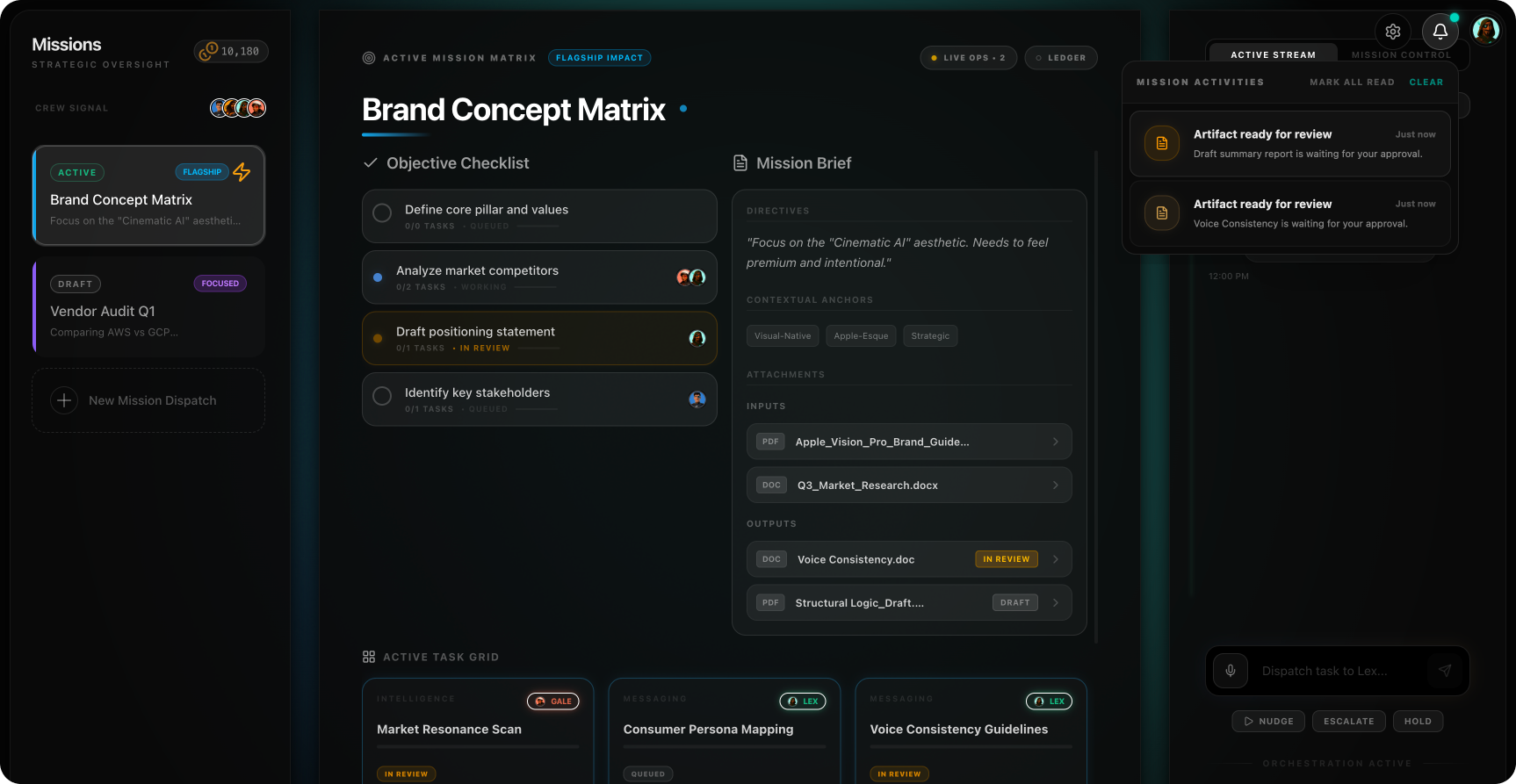
I centralized the client and agency experience around a single workspace. Using AntiGrav to accelerate iteration, I designed the checklists and real-time interaction states that keep humans securely in the loop.
Layer a cinematic, character-driven UI on top
I applied a rich, confident visual design system emphasizing characters and status indicators. This turns a dry task dashboard into an engaging 'mission control' experience for the end client.
How SuperCrew wraps your existing workflows
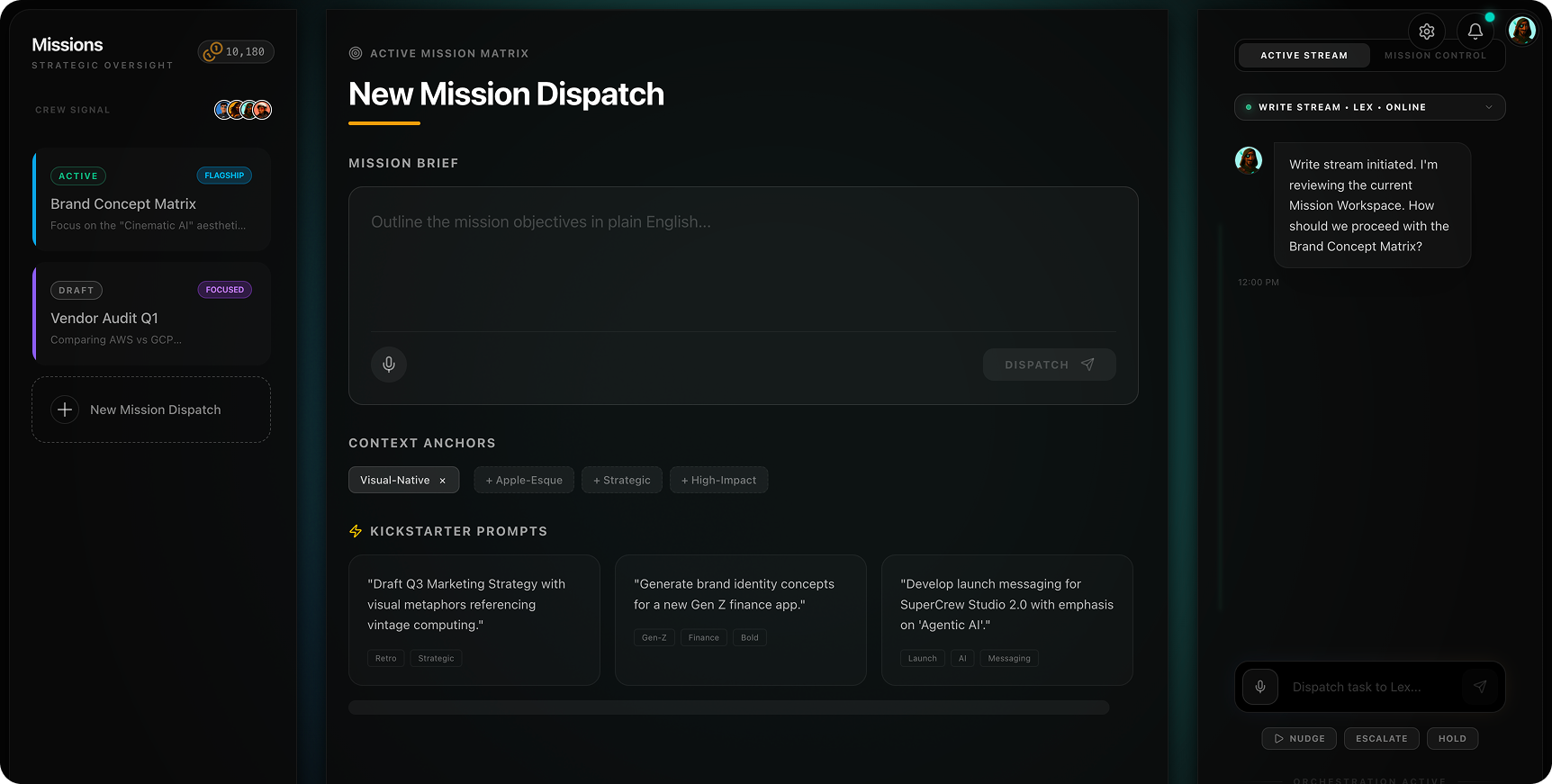
I replaced vague prompts with Mission Dispatch
SuperCrew connects to agents, tools, and data sources. A studio can plug in LangGraph flows, CrewAI agents, Zapier automations, or custom scripts without changing infrastructure.
This solves the issue of messy ingestion, giving clients a predictable format for kicking off work.
I designed one workspace for the whole mission
Loose tasks and prompts become named missions with scope, timeline, and expected artifacts. Each mission has a clear owner, status, and definition of done.
This solves scattered communication, putting the brief, the chat, and the plan into a single pane of glass.
I built Live Ops so humans stay in the loop
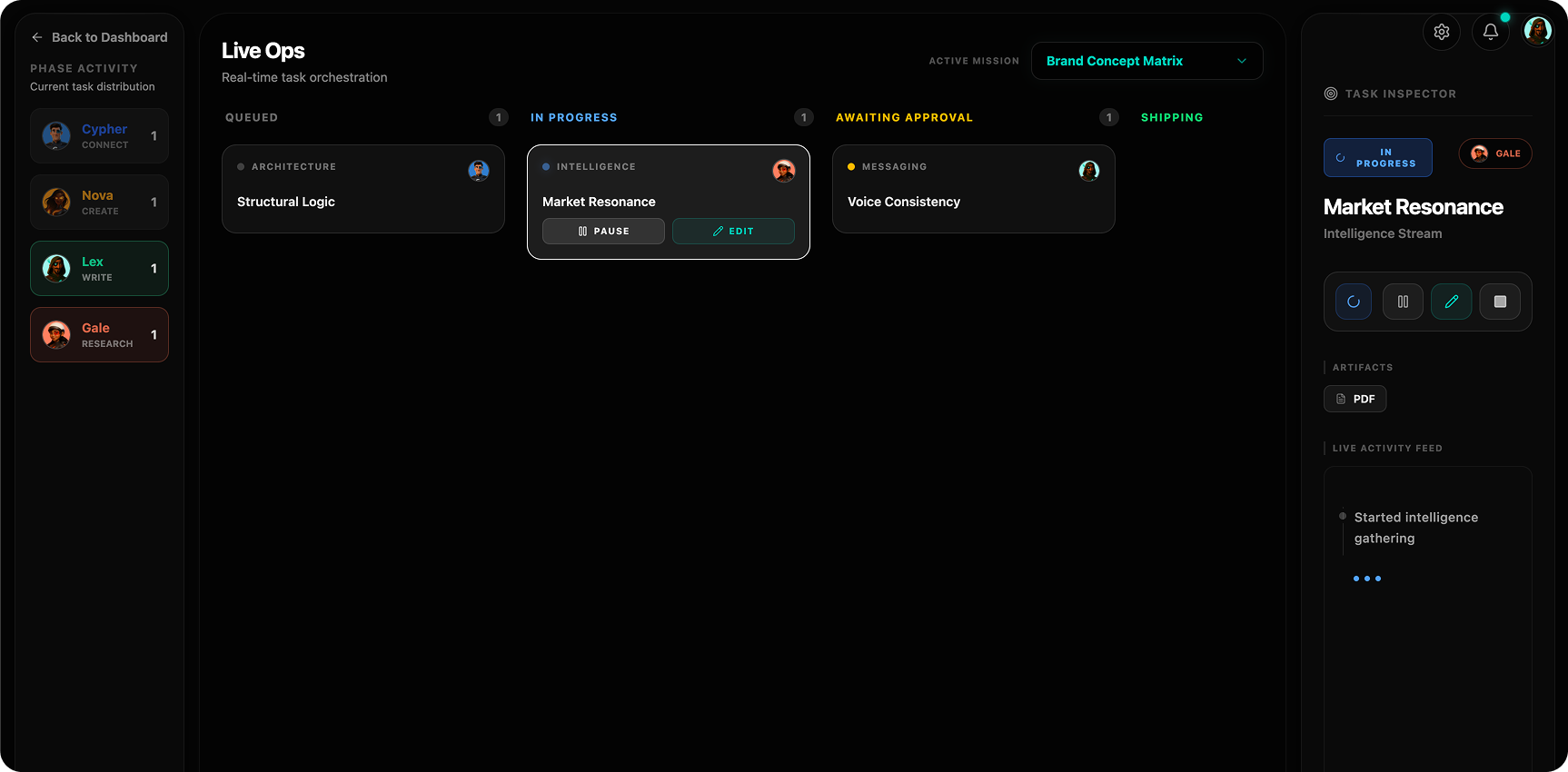
The Mission Matrix shows checklists, assignments, and live agent activity in a single view. Humans stay in the loop as reviewers and approvers without digging through logs.
This solves the anxiety of autonomous execution by surfacing clear checkpoints for human review.
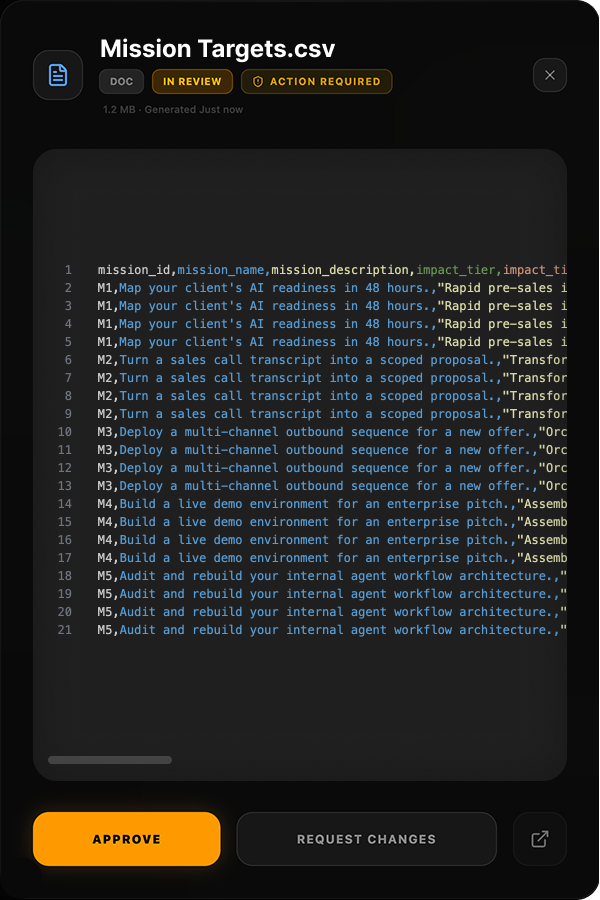
I treated artifacts as first-class deliverables
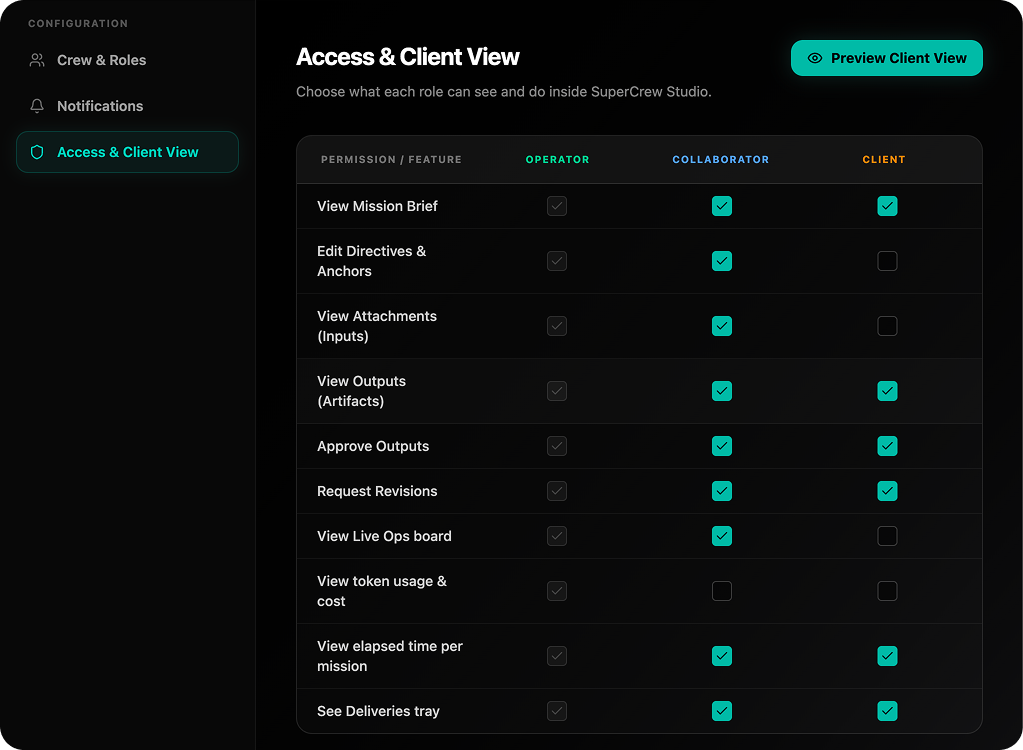
Every mission ends in exportable files—docs, decks, spreadsheets, specs—tied directly back to the work that produced them. This turns “compute” into client-ready, billable deliverables.
This solves the problem of invisible value, packaging AI output into a concrete asset a client can save.
"AI is not gonna live on its own. AI is gonna live within our technical platforms to create value."
SuperCrew Studio UI System
Under the hood, SuperCrew Studio is a reusable UI system that can be themed per studio.
- Mission-first layout – Navigation and hierarchy are organized around missions and artifacts, not tools and tabs.
- Cinematic dark theme – High-contrast HUD aesthetic, tuned for long sessions and complex state changes.
- Component library – Cards, rails, tags, avatars, and status pills built to handle many parallel missions.
- Motion language – Subtle transitions for dispatch, handoff, and approval events so state changes feel legible, not noisy.
A default crew you can completely reskin
SuperCrew ships with a sample IP (Cypher, Gale, Nova, Lex) but is intentionally designed so studios can plug in their own characters, branding, and roles without touching the underlying mission logic.
- Crew and roles are role-based, not hard-coded to my IP.
- Colors, typography, and components all come from the shared design system used in the app.
- Studios can reskin the cockpit while keeping the mission and ledger logic intact.
Cypher
ConnectNova
CreateLex
WriteGale
Research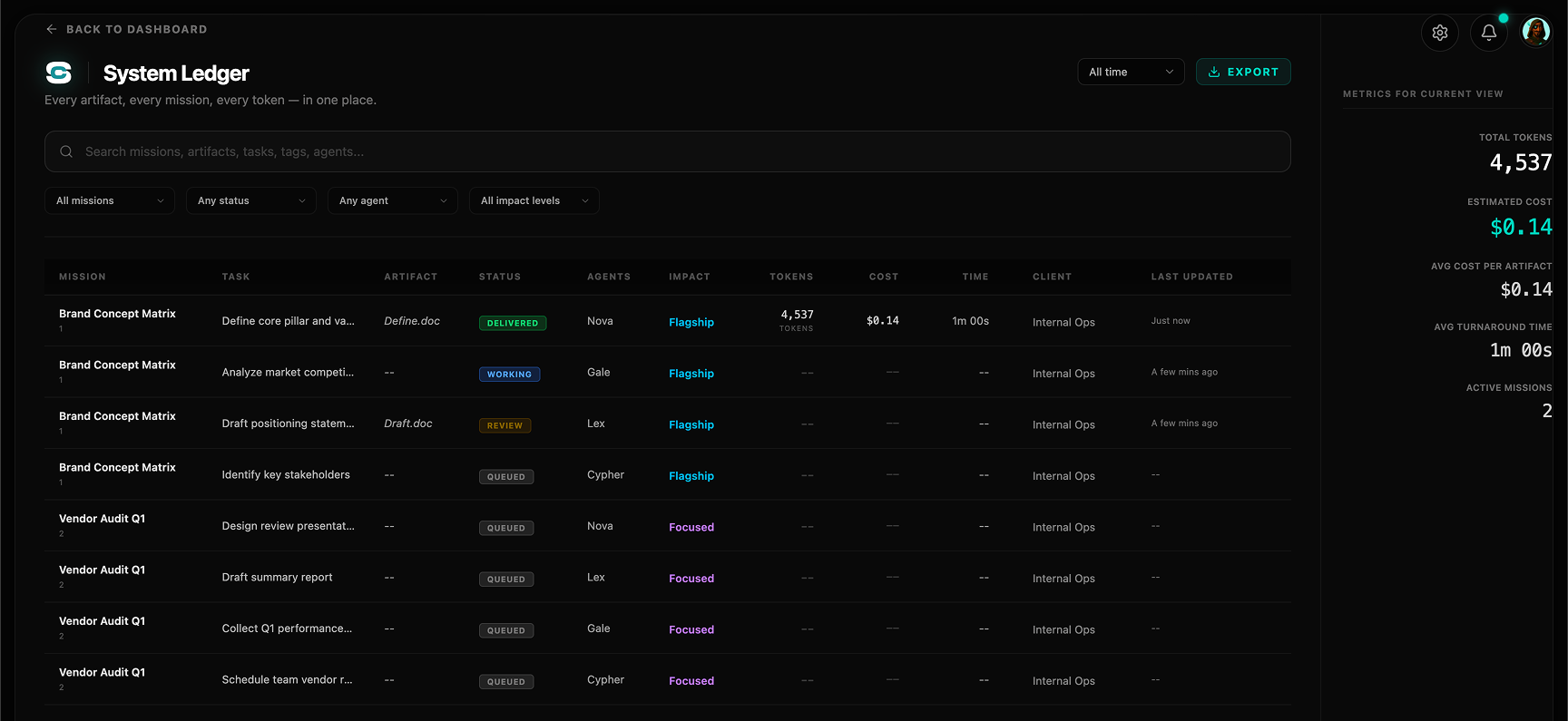
A ledger for every asset, token, and mission
I designed a system-wide ledger that tracks all activity, because visibility is the foundation of trust when dealing with AI. It records:
- Every artifact created, updated, or delivered
- Every significant agent action and tool call
- Every human review, comment, and approval
I shipped this feature to give studios a bulletproof audit trail. It makes human-in-the-loop supervision explicit, providing the necessary evidence to support pricing conversations and prove the value of the backend orchestration.
What this unlocked
- A mission model any AI service studio can map their workflows into. The abstraction layer allows for infinite backend complexity under a straightforward frontend.
- A reusable UI system for white-label, character-driven cockpits. The design system scales beautifully across different brand aesthetics.
- A foundation to plug in real HITL agent flows when needed. By leading with design, the architecture gracefully accommodates human checkpoints without feeling bolted on.
From invisible workflow to visible product
SuperCrew Studio shows how an AI service can become a mission-driven, human-supervised system—without throwing away the tools that already work.