
Continuity Across All AR Experiences
I led product design for 1 year, working with cross-functional teams across organizational lines to drive alignment and create a unified, friction-free Virtual Try-On experience for millions of Amazon customers worldwide.
Goals
- Build for worldwide scale
- Prioritize friction-free immersion
- Establish body-positive, inspirational experiences
Disjointed AR Experiences
When shopping on Amazon today, customers experience different Virtual Try-On experiences in various categories like Shoes, Eyewear, Beauty, and Furniture.
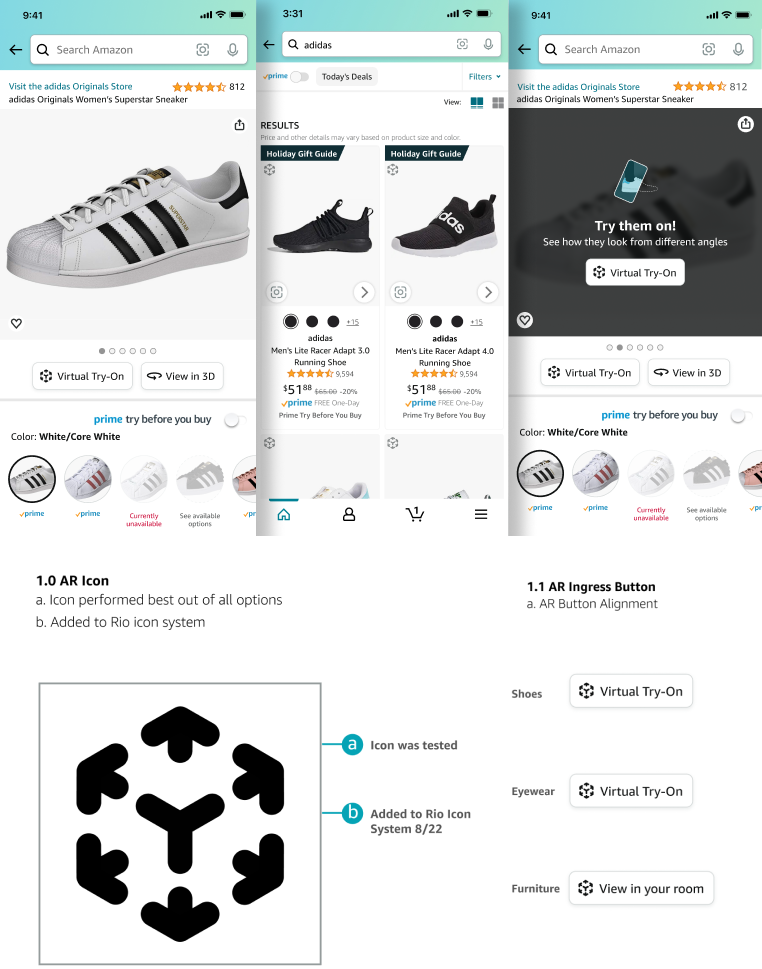
- Discoverability issues on the Search Results Page
- Inconsistent learning curves across categories
- No standard way to Add to Cart from within the experience
This inconsistency creates extra complexity and friction, making it harder for customers to fluidly adopt AR.
A Unified Ecosystem
By defining a single, integrated AR and Virtual Try-On paradigm, we aimed to:
- Create familiar interaction patterns across all categories
- Remove friction from entering and using the experiences
- Align with the Rio design standards, expanding where needed
Our goal was to make VTO feel less like a novelty and more like a native, reliable shopping utility.
Cross-team Collaborative Effort
1 · Aligning design standards
I partnered with cross-category design teams from Softlines, VSAR, Hardlines, Beauty, and Detail Page. By holding bi-weekly AR Unification Design meetings, we kept all categories in sync.
All designs were rooted in the Rio design system, with explicit blessings from Rio leadership to push its boundaries where immersive experiences required.
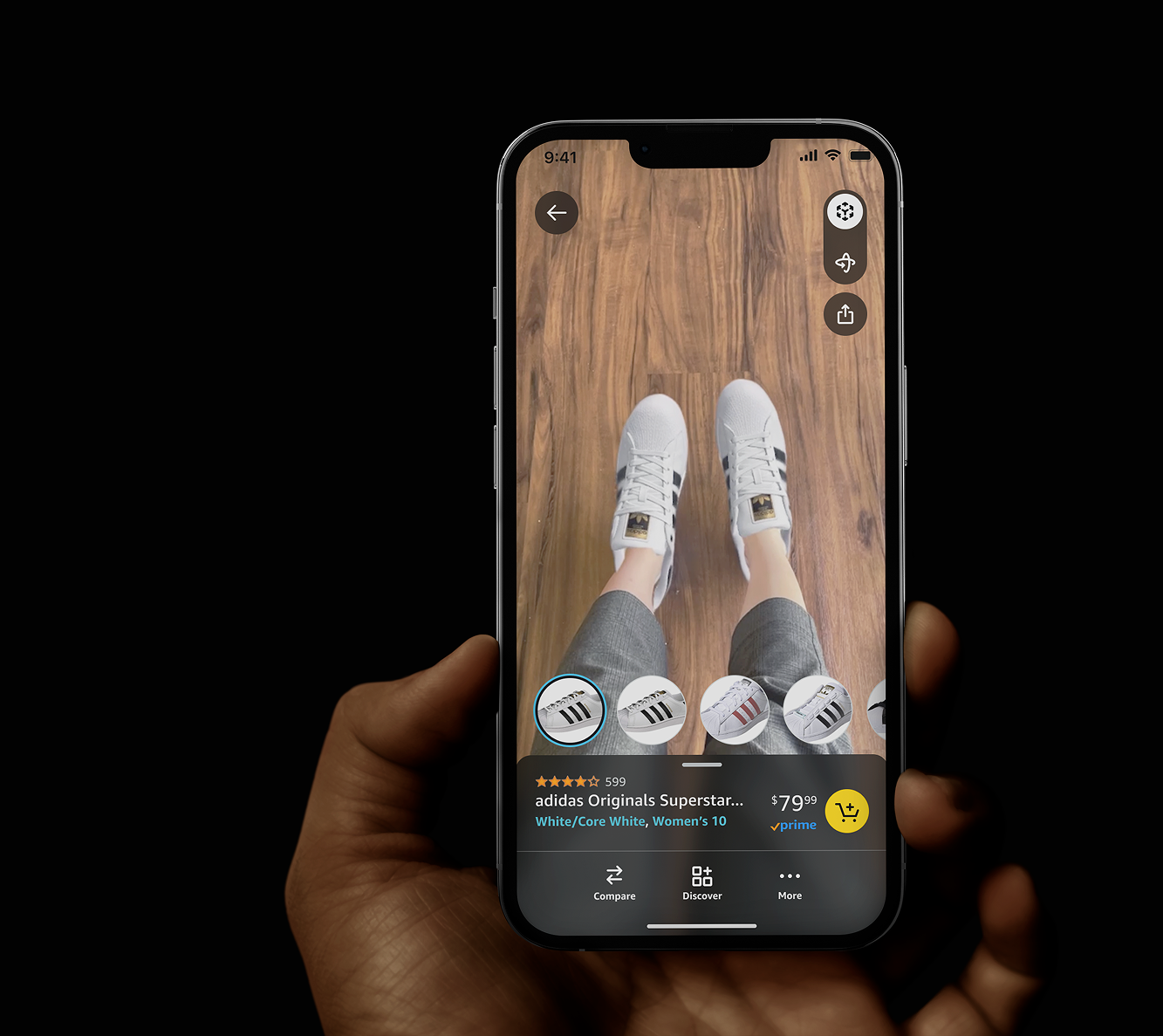
2 · Rethinking Immersion
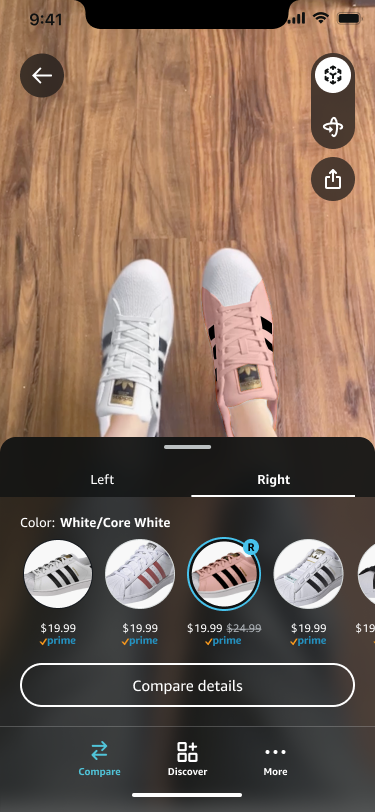
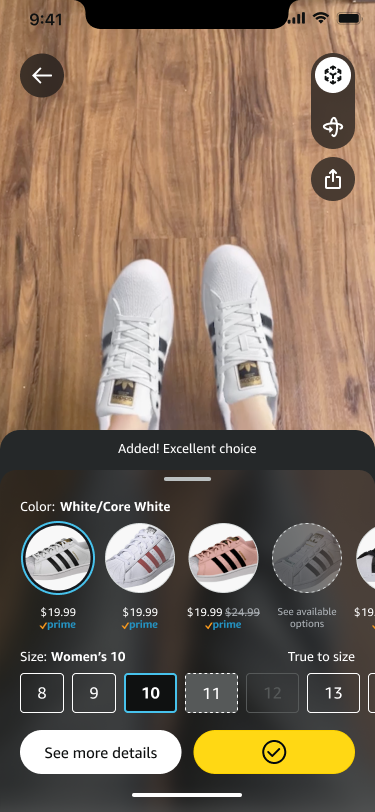
When evaluating new products, customers strongly prefer an immersive experience that prioritizes the viewfinder and try-on over traditional shopping features.
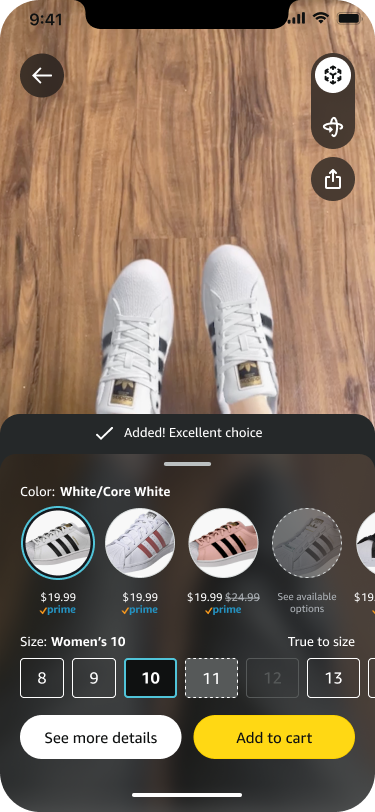
I led the interface design to gracefully prioritize the camera while seamlessly integrating primary functions—like adding an item directly to the cart—without taking the user out of the experience.
Universal Ingress & Iconography
We needed a scalable, unifying entry point. I architected the 1.0 AR Icon and AR Ingress Button alignment, standardizing how customers access VTO safely across verticals.
- Tested and established an icon system that out-performed all existing variants.
- Successfully integrated the AR icon into the core Rio design system library.
- Created standard ingress buttons for Shoes, Eyewear, Furniture, and Beauty, providing a consistent call to action.
Rewarding the Conversion Moment
Designed custom After Effects motion explorations for the core Add to Cart trigger, creating a fluid, tactile reward moment when the primary shopping goal is reached in AR.
Creating a foundation for scale
My work on unification helped transition disconnected experiments into a cohesive platform:
- Consolidated entry points across the app, reducing customer friction on millions of listings.
- Partnered closely with engineering and UXR teams to prove out the system with live usability sessions.
- Established robust, scalable guidelines ensuring long-term continuity for Amazon’s expanding AR efforts.
This alignment ensures that teams continue shipping experimental, highly-inspirational VTO experiences while relying on a stable, unified foundation.